
TEMPO.CO, Jakarta - A video collage circulated on Instagram [archive] and TikTok on June 5, claiming that farmers in Thailand and Vietnam are protesting because Indonesia will no longer import rice from those countries. The video shows demonstrators carrying Thai-language posters.
Accounts sharing the content stated that the rice import ban impacted Thai and Vietnamese farmers. Indonesia's rice import ban, which began in 2025, is said to have contributed to a 42 percent drop in global rice prices.
However, is it true that the protests in Thailand and Vietnam were caused by Indonesia's decision to stop rice imports?
FACT CHECK
Tempo verified the content using reverse image search and other credible sources. The results showed that the farmer protest in the video was not due to Indonesia's 2025 policy, which halted rice imports from Thailand and Vietnam.
Video Verification
Video 1
The clip of demonstrators carrying Thai flags is from the March 4, 2014 edition of Euronews. The protesters demanded that the Thai government continue agricultural subsidy assistance by purchasing rice from farmers.
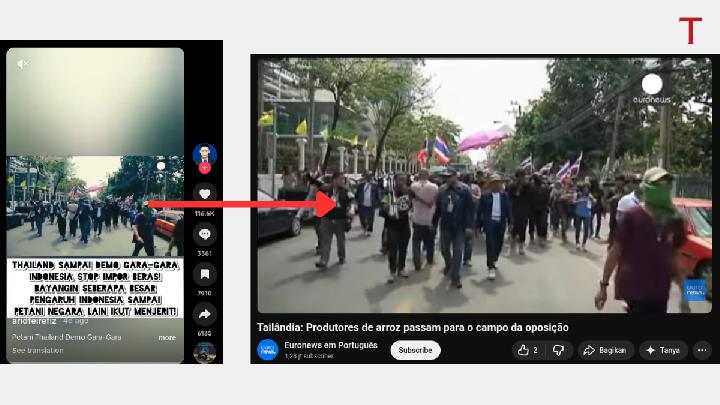
According to Behind Asia, between 2011 and 2014, Thailand implemented a populist "rice pledge scheme." Through this program, the government purchased rice from local farmers at nearly 50 percent above market prices. The program aimed to hoard rice, limit global supplies, and drive up global rice prices.
However, economic data shows the plan backfired. Global buyers turned to cheaper alternatives from Vietnam and India. Thailand lost its status as the world's number one rice exporter. In 2014, the government had 18 million tons of unsold rice in stock.
The Thailand Development Research Institute (TDRI) stated that the amount of losses resulting from this misguided policy is still being debated. The estimated losses range from 150 to 200 billion baht (equivalent to 6-8% of the 2014 government budget).
Video 2
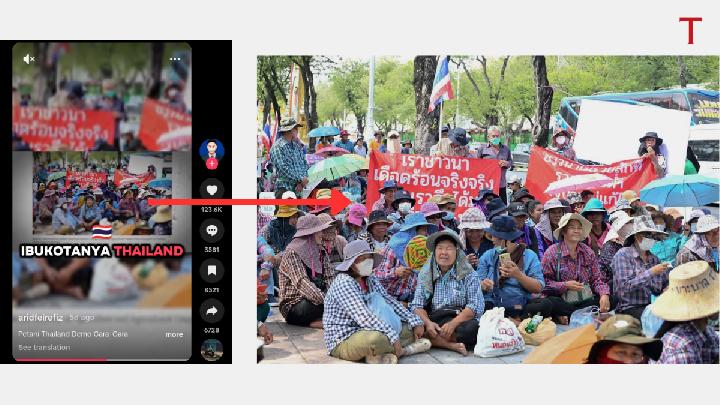
At the 42nd second, the video shows a photo of protesters waving banners with Thai writing, which comes from a Bangkok Post article published on March 4, 2025.
During the protest, around a thousand farmers marched to the Ministry of Agriculture and Agricultural Cooperatives offices, then to government buildings. They demanded a minimum price ceiling of 11,000 baht per ton for rice with a 15 percent moisture content. This was 2,000 baht higher than the current market price.
They also demanded compensation for using agricultural irrigation systems to prevent flooding in Bangkok. These systems damaged local crops, costing farmers up to 300 baht per month.
Global Rice Price Drop Unrelated to Indonesia
Claims that Indonesia's move to halt rice imports starting in 2025 will lead to lower global prices are not supported by the facts. According to data from the Food and Agriculture Organization of the United Nations (FAO), global rice prices declined in 2024-2025. However, they rose again in 2026.
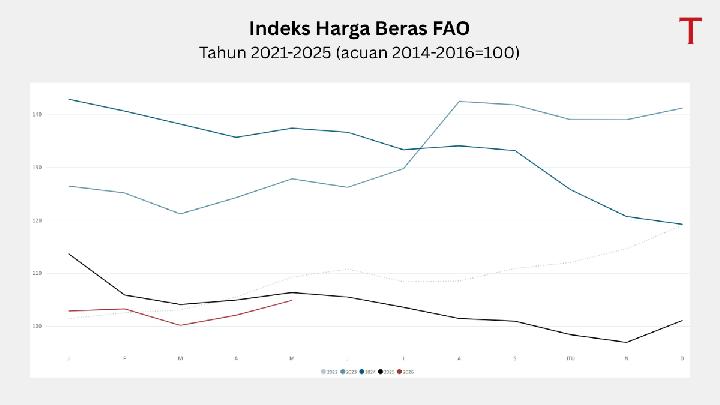
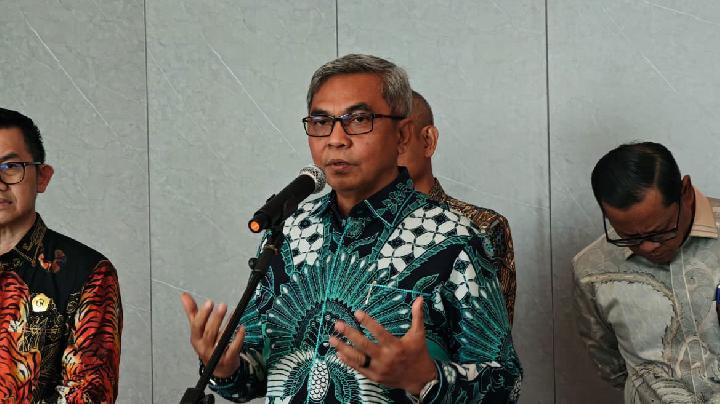
Khudori, a member of the Central Executive Board of the Indonesian Society of Agricultural Economics, stated that the decline in rice prices in 2024 and 2025 was not due to Indonesian government policy, but rather part of recurring price fluctuations. India currently controls 40 percent of the global rice market and still plays a significant role in fluctuations in rice prices.
"If India holds back its domestic stocks, global prices will soon rise," Khudori said in a written statement to Tempo on Tuesday, June 9, 2026.
According to Khudori, data from FAO and the United States Department of Agriculture (USDA) show that various exporting countries are expected to increase their rice production in 2025.
By 2025, global rice supply is projected to reach 749.1 million tons, an increase of 19.6 million tons compared to the previous year.
Furthermore, Khudori said, Indonesia is not a consistent global rice importer. According to World Bank data, China was the leading importer from 2018 to 2024, purchasing 3.393 million tons annually.
The next largest importing countries after China are the European Union, the Philippines, Indonesia, Iran, Saudi Arabia, Benin, Cote d'Ivoire, Senegal, and Malaysia.
Misleading Source of Information
The content originated from posts by Benny Batara Tumpal Hutabarat, also known as Bennix, on Instagram (June 2026) and Facebook (April 2026). Bennix is a stock investor and content creator who frequently provides commentary in support of government programs.

Bennix claimed that the Thai government had deceived Indonesia into repeatedly importing rice. Bennix also displayed photos and screenshots of Thai farmers' protests, which he claimed occurred after Indonesia stopped rice imports. He also claimed that global rice prices dropped following the halt.
Tempo requested a response via Bennix's Facebook page or the WhatsApp number listed. However, as of the publication of this article, Bennix had not responded.
CONCLUSION
Tempo's investigation found that the claim that Thai farmers protested because global rice prices fell due to Indonesia's decision to stop importing rice is false.
TEMPO FACT CHECK TEAM
**Do you have information or claims that you want to have fact-checked? Contact our ChatBot. You can also send criticism, objections, or feedback for this Fact-Checking article via email to [email protected].






















:strip_icc():format(jpeg)/kly-media-production/medias/5544736/original/021119200_1775115709-gibran_promo_motor_-_klaim.jpg)
:strip_icc():format(jpeg)/kly-media-production/medias/5378584/original/033747300_1760257934-unnamed__52_.jpg)
:strip_icc():format(jpeg)/kly-media-production/medias/3187033/original/003171100_1595400533-makkah-kaaba-hajj-muslims_21730-6508.jpg)


:strip_icc():format(jpeg)/kly-media-production/medias/5220347/original/094913800_1747281277-41961081_8976420.jpg)
:strip_icc():format(jpeg)/kly-media-production/medias/5327298/original/085035000_1756177391-Cek_Fakta_Tidak_Benar_Ini_Link_Pendaftaran__83_.jpg)
:strip_icc():format(jpeg)/kly-media-production/medias/5558454/original/058152900_1776419419-cek_fakta_-_petani_milenial_2026.jpg)
:strip_icc():format(jpeg)/kly-media-production/medias/5534796/original/005967200_1773893358-unnamed__8_.jpg)
:strip_icc():format(jpeg)/kly-media-production/medias/5552530/original/095418000_1775812020-Cek_Fakta_Tidak_Benar_Ini_Link_Pendaftaran_-_2026-04-10T153121.431.jpg)
:strip_icc():format(jpeg)/kly-media-production/medias/5534795/original/014528000_1773892938-khutbah.jpg)

:strip_icc():format(jpeg)/kly-media-production/medias/5525508/original/081861200_1773044157-Cek_Fakta_Tidak_Benar_Ini_Link_Pendaftaran_-_2026-03-09T144908.955.jpg)

:strip_icc():format(jpeg)/kly-media-production/medias/5547119/original/085428000_1775445943-Cek_Fakta_Tidak_Benar_Ini_Link_Pendaftaran_-_2026-04-06T101438.375.jpg)