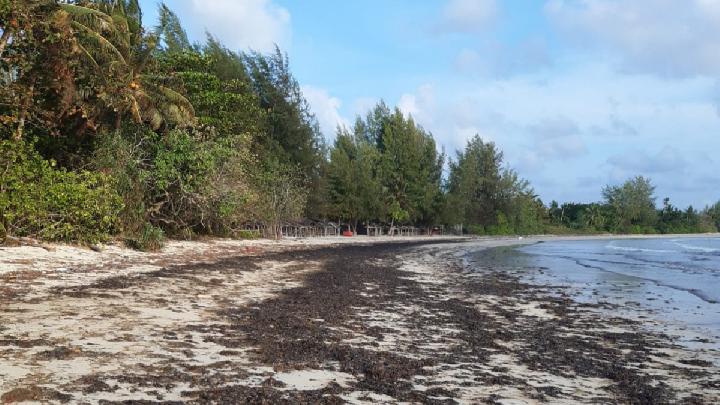
TEMPO.CO, Jakarta - The oldest rock art in the world, located in Metanduno Cave, Muna Regency, Southeast Sulawesi, is set to be designated as a national cultural heritage site. The cave site, or leang, located in Liangkobori Village, Lohia District, now holds provincial cultural heritage status.
Minister of Culture Fadli Zon stated that elevating this status is part of a comprehensive effort to protect it. "We will soon designate this as a National Ranked Cultural Heritage Site, so that the central government can more easily intervene," Fadli said during a press conference for the Nusantara Civilization Trail at the World's Oldest Ancient Painting in the Ministry of Culture building, Jakarta, on Thursday, January 22, 2026.
Based on research by the National Research and Innovation Agency (BRIN), Griffith University, Australia, and the Cultural Heritage Conservation Center, the cave paintings are 67,800 years old, older than the previous discovery of ancient paintings in Leang Karampuan, Maros Regency, South Sulawesi.
Physical protection measures also take top priority through collaboration with local governments and the Cultural Heritage Conservation Center of Southeast Sulawesi to prevent damage from natural factors and direct human contact.
In addition, the government plans to develop a sustainable historical tourism ecosystem while still prioritizing conservation, including considering expert suggestions on access restrictions or using replicas to maintain the integrity of the paintings.
Uniqueness of Leang Metanduno Paintings
In addition to their age, the ancient paintings in Metanduno Cave boast unique aesthetic qualities. Fadli said the paintings are handprints created with a technique that involves spraying red ochre. What sets these findings apart from those found elsewhere is the artistic touch: when the hand is pulled from the cave wall, an image of pointed fingers is created.
"It's a hand, probably sprayed with red ochre, but it also shows an effort by the ancestors not only to make a print of their hand, but also to create some kind of sharpened creation," Fadli said.
Researchers explain that this finding proves that the area's ancestors were skilled seafarers and artists. In the Muna region, it is estimated that there are around 50 caves containing hundreds of paintings that depict the continuity of civilization. These paintings include illustrations of animals, boats, and kites.
Fadli Zon said these ancient paintings are proof that our ancestors had a culture 67,800 years ago. "This is an important part of the early history narrative of the Nusantara civilization," he said.
Imanda Zahwa Priyankany contributed to this article
Read: Fadli Zon: Rock Paintings Prove Indonesia's Oldest Civilization
Click here to get the latest news updates from Tempo on Google News

























:strip_icc():format(jpeg)/kly-media-production/medias/4174191/original/099991100_1664358430-bacaan-doa-setelah-adzan-beserta-arti-dan-keutamaannya.jpg)
:strip_icc():format(jpeg)/kly-media-production/medias/5385863/original/035777200_1760946460-KIP_Kuliah.jpg)
:strip_icc():format(jpeg)/kly-media-production/medias/5502852/original/043074800_1771048777-4.jpg)