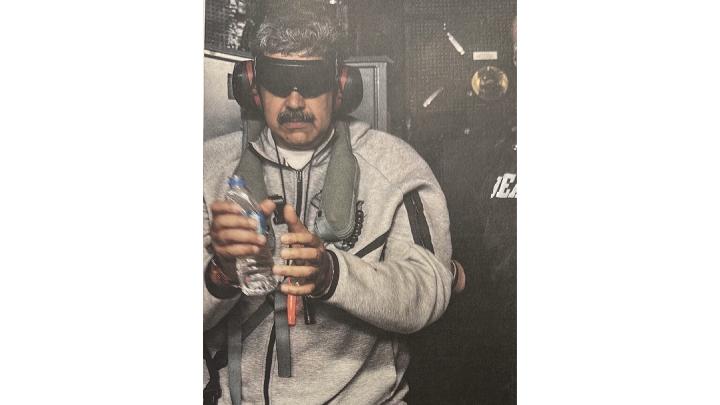
TEMPO.CO, Jakarta - Nicolas Maduro showered Vladimir Putin with praise during his visit to Moscow on Victory Day in May 2025. The Venezuelan leader described Russia as "a key power of humanity," and the two heads of state signed a cooperation agreement.
But on January 3, Russia stood back and watched as the US forcibly brought Maduro and his wife to New York, where they are being tried for drug trafficking.
Russian air defenses failed to protect Maduro
Three days after the fall of the Venezuelan president, Putin remained silent. The Russian Foreign Ministry expressed its concern and called for Maduro's release and negotiations between the US and Venezuela. According to official reports, after a phone call in early December, Maduro received a New Year's greeting from the Russian president.
Maduro was one of the few heads of state who supported Russia in February 2022 when Moscow recognized the separatist pseudo-republics of Donetsk and Luhansk before launching its major attack on Ukraine.
In December 2018, Russia sent two Tu-160 strategic bombers to Venezuela for exercises, which experts interpreted as a sign of support for Maduro. They landed at Caracas airport — the same airport used by the US to fly out the Venezuelan leader in handcuffs.
But Russian air defenses were unable to protect the disputed leader during last week's operation, as US Defense Secretary Pete Hegseth has pointed out.
Why is Putin keeping quiet about Trump?
"Russia's support for Venezuela has been more symbolic than practical," Neil Melvin, an expert at the Royal United Services Institute, told DW. In his view, Russia is not in a position to challenge the deployment of US forces in the neighboring region.
Felix Riefer, a German political scientist and author of a book on Russian foreign policy, also said he was not surprised by Putin's response. After Trump's return to the White House led to a rapprochement between Moscow and Washington, Russia responded to "American hints toward Venezuela with relative restraint," he said. "Russia had already abandoned Maduro."
Both experts said a key explanation for Putin's silence is Russia's ongoing war against Ukraine and the US shift from being Kyiv's partner to acting as a mediator in talks. Russia is keen to avoid harsh criticism of Washington because it does not want to cause offense, according to Melvin. In his opinion, Moscow's rhetoric on the events in Venezuela would be "significantly harsher" if it weren't for the war against Ukraine.
The British expert saw no immediate consequences for the war in Ukraine. This could change if Trump does not stop at Venezuela but goes further and, for example, attempts to annex Greenland, which belongs to Denmark — something the US president recently hinted at again.
Melvin believes that NATO would probably not survive such a development. Danish Prime Minister Mette Frederiksen expressed a similar view on Monday.
Cautious optimism in Ukraine
Kyiv, meanwhile, is keeping close tabs on events in Venezuela. "If dictators can be treated this way, then the United States knows what to do next," President Volodymyr Zelenskyy said earlier this week. The Ukrainian Foreign Ministry reiterated that it does not recognize Maduro as president.
Experts in Kyiv are cautiously optimistic. Markets expect relations between the US and Venezuela to normalize in the foreseeable future, which will open Venezuela up for oil production and have a significant impact on the global economy and oil prices, said political scientist Petro Oleshchuk of Taras Shevchenko National University of Kyiv.
"Anything that lowers oil prices is beneficial for Ukraine and could have a positive impact on negotiations. The cheaper oil is, the less money Russia has at its disposal, making the idea that Russia is prepared for an endless war seem less and less credible," Oleshchuk said.
Some media outlets have suggested the US could weaken its role as a democratic negotiating partner by arresting Maduro. However, experts interviewed by DW are skeptical. According to Oleshchuk, the US military's intervention is in line with the US doctrine of the Western Hemisphere as a sphere of interest.
He noted that it's impossible to draw parallels between Maduro's arrest and Russia's aggression against Ukraine.
"In the case of Venezuela, the US is not annexing territory and is not claiming that Venezuela is a fictitious state," he said.
Experts cast doubt on stability of Russia's position
Political scientist Riefer said Russia could try to use the case of Venezuela to justify its aggression against Ukraine. While this is a possible outcome, "a direct comparison is flawed," he said.
Riefer is convinced Moscow's reputation in the world has been weakened, saying "those who rely on Russia cannot hope to be protected."
Melvin, meanwhile, emphasized that this is not the first time that Putin has let an ally go. "Russia has lost Armenia, Syria and now Venezuela," he said. "Russia's international position is weakening noticeably as it escalates its war against Ukraine and lacks the resources to maintain such relationships."
In the case of Cuba, Russia's most important partner in Latin America and one of Venezuela's closest allies, Moscow's protests may be louder, added Melvin, but Russia's options are ultimately "very limited." Cuba has been among the countries that were recently verbally attacked by Trump.
Read: Maduro's Downfall Deals China New Cards in US Rivalry
Click here to get the latest news updates from Tempo on Google News
















:strip_icc():format(jpeg)/kly-media-production/medias/4770150/original/051663000_1710247846-20240312-Berbuka_Puasa_di_Istiqlal-HER_2.jpg)


:strip_icc():format(jpeg)/kly-media-production/medias/5417338/original/087225200_1763529762-Buka_Puasa.jpg)